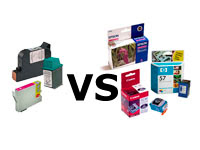
 Late in April, 2007, an authoritative review website TrustedReviews.com posted the results of one interesting test. They compared inks and paper made by third party manufacturers against those made by printer makers. The goal of the test was to determine if third-party inks and paper provide same level of quality as original manufacturers’.
The printers tested were multifunctional inkjet printers of major brands most common models used by home and small office users, namely Canon PIXMA MP600, Epson Stylus Photo RX640, HP OfficeJet 6310 and Lexmark X5470. The jury comprised of typical printer users rated printouts made of combinations of third-party and original inks and paper on the scale of 1 to 10, where 9 or 10 would be “a print you'd be happy to have as a record of a wedding or important birthday”, and scores below 5 for “prints you would be unlikely to keep because of their quality.”
The testing revealed several amazing facts, but the most important one is this:
The jury scored prints produced with third-party inks higher than those produced with manufacturer’s own products.
That means compatible cartridges of known can generally provide same quality, and in some cases, even better quality then OEM cartridges. I’m not talking about defective unknown brand cartridges or over-refilled cartridges with long-expired duty cycle. Just like everywhere, trust the brand that provide high quality of its products, in our case Cartridge World or InkTecShop.
But the judges are just simple printer users with no technical background, you may argue. Yes, that is true. However, they are exactly who buy ink cartridges, and hence, who pay money. So it’s up to simple users to decide what’s good for them, and them will finally choose what is more savvy
As you know, compatible cartridges cost 25% to 75% less than original cartridges. But I believe it’s vice verse - original cartridges are up to 75% more expensive. Think about this. It makes sense to assume that third-party producers also have research laboratories to devise ink formulation, just like printer brands. Both third-party and original makers have plants to produce cartridges somewhere in third-world country to make them cost-effective. So, where is the catch? Why such price difference?
There’s
a good article by Marshall Brain, where he discusses the price of things. In particular, he compares an inkjet cartridge and a microwave oven and finds their prices somewhat equal (as of 2004). He goes on:
“So think about this: The microwave oven contains a microprocessor, the software for the microprocessor, a keypad/display for the microprocessor and a separate power supply for it. The microwave oven also contains a 700 watt Klystron to generate the microwaves, the waveguides for Klystron and the high-voltage power supply it needs. Then there is the door, the hinges, the latch, the safety interlocks on the latch, the light, all the internal fusing, the metal case, the interior, etc. There's also the process of getting UL listed and so on. A microwave oven weighs 30 pounds and once cost thousands of dollars. Mass production has dropped the price on microwaves significantly in the last decade or two.
By comparison, an ink jet cartridge is a piece of plastic, a couple of dozen jets, a little wiring and some ink. The total cost to manufacture is probably less than a dollar. Yet they sell for $38.99.”
When first appeared on the market 20 years ago, a microwave oven cost $1,000 or so. Over years, the price gradually slid down to, well, not $28.44, but $70 for sure, that is 15 times less. On the other hand, over the same 20 years of market presence inkjet cartridges price hardly half-dropped.
No matter how complex, heavy-patented and expensive a product is, once it’s placed on the consumer market, it’s doomed to become cheaper – technology advances, materials improve, and production becomes more effective. It’s just as natural for prices on goods to go down as for humans to age over time.
That does not seem to be the case with printer cartridges.
What is it? A conspiracy of printer makers? An ‘anti-customer’ marketing strategy? We’ll never know. Bad thing is we’ve been dealing with it for too long. Good thing is there is always an alternative – the compatibles.


